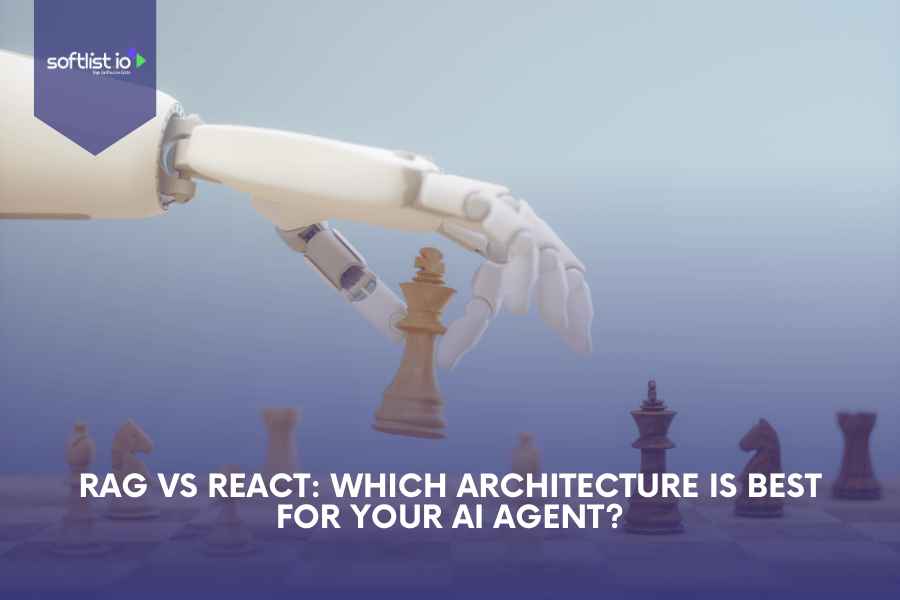
AI agents are evolving rapidly, and the architecture behind them plays a crucial role in determining their effectiveness. Two of the most widely discussed approaches today are Retrieval-Augmented Generation (RAG) and Reason and Act (ReAct). While RAG focuses on grounding responses in reliable external knowledge, ReAct emphasizes reasoning and decision-making through the use of tools and step-by-step actions.
Choosing the right framework isn’t just a technical detail—it can determine whether your AI agent delivers accurate answers, handles complex workflows, or both. This guide breaks down RAG vs ReAct to help you decide which is best.
Key Takeaways
- RAG grounds AI with accurate knowledge.
- ReAct enables reasoning, actions, and adaptability.
- Choice depends on goals and tasks.
- Tools extend retrieval, reasoning, and automation capabilities.
- Hybrid blends accuracy with flexible workflows.
What is RAG?

Source: Canva
Retrieval-Augmented Generation (RAG) is an AI architecture designed to improve the accuracy and reliability of large language models (LLMs). Instead of relying solely on the model’s internal training data, RAG connects the model to an external knowledge base.
When a user submits a query, the system retrieves relevant documents, and then the LLM generates a response. This hybrid approach combines retrieval with reasoning, allowing the model to adapt its approach to ensure the information is accurate, contextually relevant, and consistently up-to-date.
The workflow of RAG typically follows three steps:
- Knowledge Base Connection – The model is linked to a database, document repository, or vector store.
- Retrieval – When prompted, the system pulls the most relevant information based on semantic similarity or keyword matching.
- Generation – The LLM uses the retrieved content as context to craft a coherent, grounded answer.
RAG reduces hallucinations by tying responses to curated knowledge. An agent might first start by querying a database, then rely on LLMs to generate answers, enhancing accuracy and the ability to adapt across diverse contexts.
What is ReAct?
Source: Canva
The ReAct framework (Reason + Act) is designed to give AI agents both the ability to think through problems and the power to take meaningful action. Unlike standard models that only generate answers, ReAct agents combine logical reasoning with tool use—making them far more versatile.
How It Works:
- Reasoning (the “R”): The model breaks a task into smaller steps, planning its approach before jumping to conclusions.
- Acting (the “A”): Once a step is clear, the agent executes an action—this might mean calling an API, running a database query, or searching the web.
- Feedback loop: Each action feeds back into the reasoning process, allowing the agent to refine its plan until it reaches a reliable result.
RAG vs ReAct: Comparing AI Architectures

Source: Canva
Here’s a concise comparison of RAG vs ReAct architectures to guide your choice:
| Aspect | RAG (Retrieval-Augmented Generation) | ReAct (Reasoning + Acting) |
| Goal | Enhance answers with up-to-date external knowledge | Solve tasks by breaking them into steps—reason and take actions |
| Strength | Reliable, fact-based, grounded answers | Multistep problem solving, workflow execution, tool use |
| How It Works | Pulls info from connected data (docs, DBs, APIs) before responding | Alternates reasoning (“thoughts”) and running actions (APIs, tools) in a loop |
| Use Cases | Knowledge assistants, chatbots, research tools | Task automation, virtual assistants, agents needing planning |
| Dependencies | Depends on quality/reach of information sources | Depends on carefully designed action “toolkit” for the agent |
| Transparency | Traceable—shows where data came from | Traceable—reasoning steps and actions are visible |
| Simplicity | Easier to set up for Q&A, info retrieval | More complex orchestration for multi-step tasks |
When to Use Each

Source: Canva
Choose RAG for knowledge delivery and ReAct for reasoning and automation. Many advanced agents use both.
- Use RAG for agents focused on delivering up-to-date, accurate information using external sources, ideal for customer support and research tools.
- Use ReAct for agents that automate tasks, run searches, make API calls, or need stepwise reasoning—best for workflow automation and analysis. This highlights the core difference in how RAG vs ReAct address distinct AI agent needs.
- Combine both to enable document search and real-world actions, such as messaging and CRM updates, within a single enterprise agent.
The best framework depends on your goals: use RAG for accuracy, ReAct for flexible actions, or both for a balanced approach. In short, the RAG vs ReAct decision comes down to whether your priority is accuracy, flexible actions, or a blend of both.
Summary Table
| Use Case | RAG | ReAct | Both |
| Facts / Q&A (chat, support) | ✓ | ||
| Breaking down complex tasks | ✓ | ||
| Task automation / workflows | ✓ | ||
| Up-to-date, truthful answers | ✓ | (indirect) | |
| Multi-step decision + info | ✓ | ||
| Agents in regulated industries | ✓ | ✓ | ✓ |
Tools to Support Both RAG and ReAct Architectures

Source: Canva
While RAG vs ReAct represent two distinct AI architectures, the most effective agents often rely on versatile tools that enhance either approach.
The following platforms supply real-time data, extend functionality, and streamline automation—making them valuable whether your AI agent is built on RAG vs ReAct, or a hybrid of both.
Brand24
A real-time monitoring platform that fuels RAG with fresh knowledge and supports multi-step reasoning. Just like ReAct, the agent helps refine insights, can build query engine workflows, and integrates with open-source tools—keeping AI outputs contextually relevant and actionable in dynamic environments.
Key Features
- Live data streams from social media, blogs, and news
- Sentiment analysis for deeper context
- Alerts for trending topics and conversations
Best For: Businesses that need their AI agents to stay updated with real-time insights while grounding responses in accurate, current data.
Get AI-powered access to mentions across social media, news, blogs, videos, forums, podcasts, reviews, and more.


AI Top Tools
A comprehensive directory for discovering AI capabilities that enhance the generation of responses and optimize the generation process.
It supports how RAG provides grounded answers while adapting to the current language of the user, ensuring agents access cutting-edge functions across RAG vs ReAct retrieval and reasoning workflows.
Key Features
- Curated listings of AI apps and services
- Easy discovery by use case and category
- Frequent updates with new tools and features
Best For: Developers and enterprises wanting to expand their AI agent’s toolkit quickly and effectively.
Gain access to expert insights, tips, and strategies on how to leverage AI tools effectively for marketing and productivity!

AI Agent Store
A marketplace offering prebuilt agents designed for RAG vs ReAct systems, built like LangChain.
It enables faster development where an agent retrieves data, combines reasoning traces and actions, and excels at question answering, workflow automation, and flexible AI solutions.
Key Features
- Ready-to-use agent templates
- Extensions for specific workflows
- Community-driven ecosystem for sharing components
Best For: Teams looking to accelerate deployment by leveraging prebuilt solutions that can be customized for knowledge retrieval or reasoning-action use cases common in RAG vs ReAct agents.
Think of it as a store filled with specialized AI assistants, each designed to help in different ways. Buy or find a free AI agent suitable for the job which needs to be done.

Flow XO
A workflow and chatbot automation tool that bridges RAG and ReAct approaches by enabling knowledge retrieval alongside reasoning-action loops in one unified environment.
It helps AI perform tasks efficiently, allows AI to integrate multiple AI tools, and supports AI-driven automation. This makes Flow XO a perfect showcase of how RAG vs ReAct can work hand-in-hand in enterprise AI.
Key Features
- Chatbot builder with multi-channel support
- Workflow automation with logic branching
- Integrations with APIs, CRMs, and messaging apps
Best For: Organizations that need to combine structured knowledge delivery with automated task execution in their AI agents.
The ‘intelligence’ behind a Flow XO chatbot is created using a powerful workflow, and you can have an infinite number of these running in your chat window.

Conclusion
The choice between RAG vs ReAct comes down to your goals. RAG is ideal for tasks that require grounded, accurate information. ReAct excels when agents must plan, act, and integrate with real-world tools and systems. This shows why many advanced AI frameworks approach RAG vs ReAct as complementary—often, combining both delivers the right balance of accuracy and flexibility.
Overwhelmed by software choices? Softlist.io simplifies the process with clear reviews and actionable insights on the Top 10 AI Automation Tools—covering solutions built for RAG vs ReAct use cases—helping you find the right solution quickly.
FAQs
How does ReAct outperform RAG?
ReAct outperforms RAG by combining reasoning with action, enabling multi-step workflows, ai tools integration, and dynamic decision-making. This approach helps AI handle complex tasks more effectively, allows AI to adapt in real time, and powers AI-driven workflows beyond static, retrieved knowledge.
Static RAG vs Agentic RAG?
Static RAG retrieves from knowledge bases, while Agentic RAG adds reasoning loops for iterative refinement and tool interaction. By leveraging RAG, stronger grounding emerges. When RAG combines with reasoning, AI systems give a more helpful result. To maximize adaptability, teams setup ReAct for dynamic, action-driven problem-solving.
Why is Agentic RAG better for complex tasks?
Agentic RAG refines queries, chains retrieval steps, and adapts in real-time to retrieve relevant information. An agent might improve results through iterative thought process, integrating reasoning with retrieval. This enhances artificial intelligence by combining knowledge with action based decision-making, surpassing traditional RAG limited by static workflows and missing feedback loops.
How do retrieval strategies differ?
RAG prioritizes document retrieval for grounded responses, while ReAct uses retrieval selectively during reasoning steps. In this agent architecture comparison, ReAct enables dynamic AI agent design that integrates real-time searches with tool actions to solve complex queries from user queries iteratively.
Which is more reliable in real-time?
ReAct ensures reliability in real-time environments through reasoning-action loops and adaptive workflows, while RAG systems work best for stable knowledge retrieval but falter in dynamic contexts. Frameworks like LangChain and LlamaIndex enhance both within Generative AI pipelines. An AI assistant powered by OpenAI can combine RAG for QA with ReAct for adaptive tasks, creating a more balanced, effective solution.