
Video production tools fall into three distinct categories, each serving different workflows and project demands. Traditional video editors handle comprehensive post-production tasks, AI generators create content from prompts or templates, and motion suites specialize in animations and visual effects. Choosing the right category depends on your deliverable type, turnaround requirements, creative control needs, and budget constraints.
Key Takeaways
- Traditional editors deliver frame-accurate control for complex storytelling and broadcast-level polish.
- AI generators excel at rapid drafts, social formats, and scalable variations.
- Motion suites unlock custom animation, compositing, and branded motion systems.
- Hybrid workflows cut time-to-approval by drafting in AI and finishing in an NLE.
- Tool choice should match deliverable, timeline, brand control, and team skill.
Traditional Video Editors: Maximum Control and Professional Output
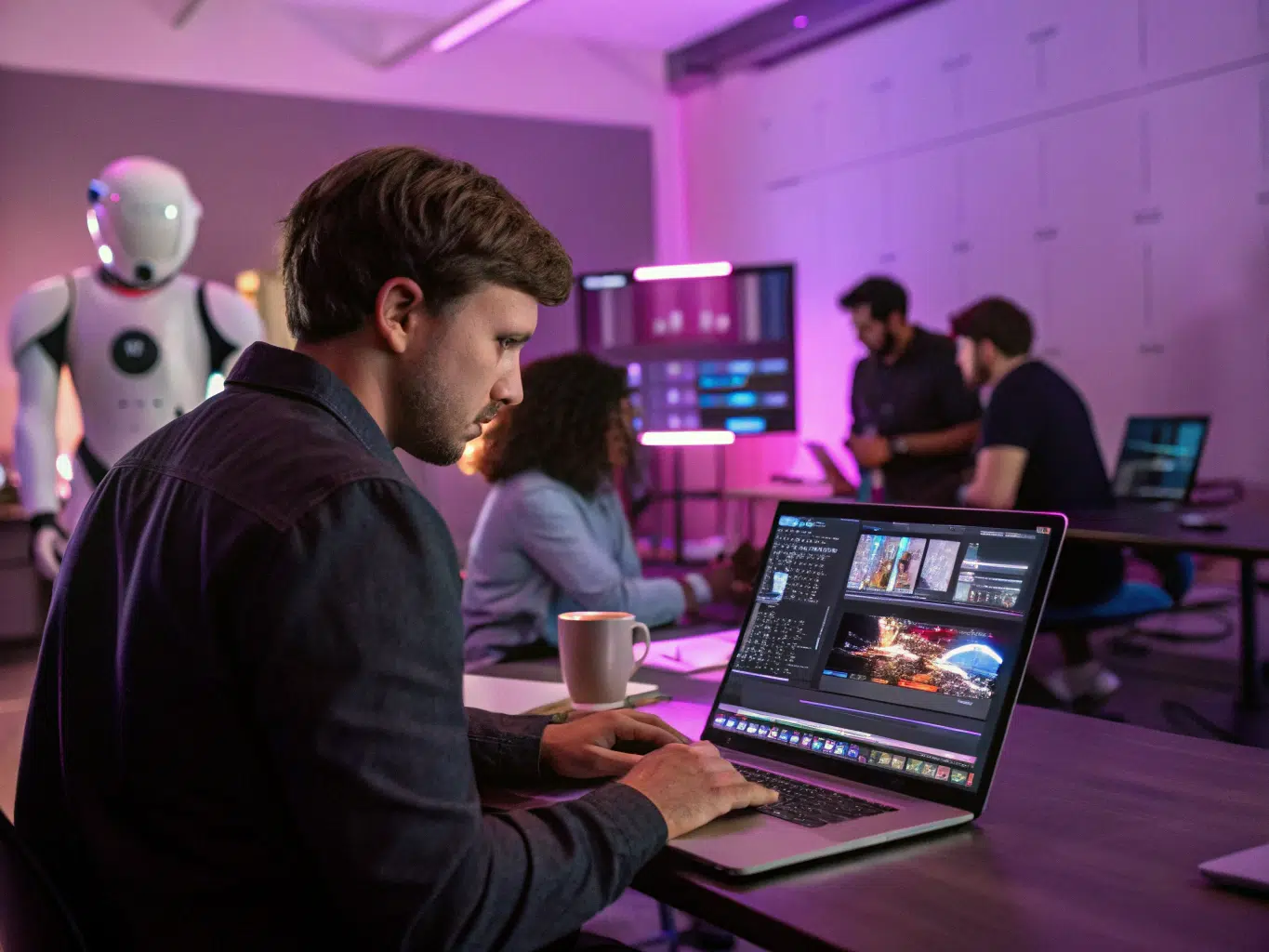
Traditional editors like Adobe Premiere Pro, Final Cut Pro, and DaVinci Resolve provide frame-level precision for complex projects. These platforms handle multi-camera synchronization, advanced color correction, and professional audio mixing that AI tools cannot replicate. G2 reviewers consistently rate Premiere Pro and Final Cut Pro as industry standards for professional work, with Camtasia earning praise for tutorial creation.
Learning curves range from moderate to steep depending on your chosen platform. Final Cut Pro offers intuitive magnetic timeline editing for Mac users, while Premiere Pro delivers cross-platform compatibility with extensive third-party plugin support.
Core Capabilities
- Multi-track timeline editing with unlimited layers
- Professional color grading and audio mixing tools
- Advanced keyframing for custom animations
- Raw footage processing and format conversion
- Collaborative review and approval workflows
- Integration with motion graphics and audio software
Best Use Cases
- Documentary and narrative film production
- Corporate videos requiring brand consistency
- Multi-camera event coverage and interviews
- Projects with complex audio requirements
- Content requiring custom motion graphics integration
Traditional Video Editor Platforms

Image Source: WeVideo
WeVideo
WeVideo earns a place as a cloud NLE for teams that need browser-based collaboration without sacrificing timeline control. You still get multi-track editing, keyframing, transitions, and brand assets—just accessible from anywhere.
How it works:
- Start a project
- Upload media to the shared library, then
- Build rough and fine cuts directly in the browser
Reviewers can comment without sending heavy files around. The Brand Kit keeps fonts, colors, and logos consistent across episodes or campaigns.
Special features:
- Cloud rendering (no beefy GPU required)
- Stock libraries, green-screen keying
- Voiceover recording in the editor, and
- Team roles/permissions
Because it’s a traditional editor at heart, you maintain shot-level control—vital for client revisions, continuity, and precise audio mixing—while enjoying SaaS convenience. Use WeVideo for distributed teams, schools, marketing departments, and agencies that value low IT overhead and easy approvals, yet still need the reliability of manual editing over AI-only automation.
Our flagship online video editor comes fully loaded with easy-to-use editing tools, 1M+ stock assets, screen recording, and big-budget effects (no big budget required!). Turn your ideas into professional-grade videos with just a few clicks.



Image Source: Movavi
Movavi Video Editor
Movavi belongs here because it works like a streamlined NLE: tracks, trims, titles, color tools, and exports with predictable control.
Workflow:
- create a project
- drag clips to the timeline
- trim and split, then
- add transitions/titles from the sidebar.
The Fast Track Montage wizard drafts a rough cut; you refine pacing manually. AI features (background removal, noise/scratch reduction, stabilization) save time, but you still make the final creative calls.
Special features include:
- straightforward screen-record + editor integration for tutorials
- quick social aspect-ratio switching, and
- “highlight/zoom” tools for instructional cuts.
It’s a strong midpoint for creators who’ve outgrown simple web editors but don’t need the depth (or learning curve) of pro suites. Use Movavi when deliverables must be consistent and on-brand, but deadlines are tight and your team prefers an intuitive interface over deep menu diving. For SMB brand films, product explainers, or YouTube series with repeatable formats, Movavi’s balance of speed and manual control is spot on.
A powerful video-making bundle that includes a video editor, file converter, screen recorder, and other goodies to make you a content guru

AI Video Generators: Speed and Automation for Rapid Content

AI-powered video creation tools transform text prompts, images, or basic footage into finished videos within minutes. These platforms excel at generating social media content, concept videos, and templated presentations without traditional editing skills. According to recent industry analysis, AI tools increasingly integrate into modern video production workflows for initial concept development and rapid iteration.
Current AI generators handle specific tasks well but struggle with complex narratives or brand-specific styling. They work best for standardized content formats like social posts, product demos, or internal communications where speed matters more than creative uniqueness.
Automation Features
- Text-to-video generation from written scripts
- Automatic scene transitions and pacing
- Voice synthesis and auto-generated captions
- Template-based styling and branding
- Batch processing for multiple variations
- Direct publishing to social platforms
Limitations to Consider
- Limited customization beyond template parameters
- Generic styling that may not match brand guidelines
- Difficulty with complex storytelling or narrative flow
- Potential licensing issues with generated content
- Quality inconsistency across different content types
AI Video Generator Platforms

Image Source: Pictory
Pictory
Pictory fits the “AI generator” lane by turning scripts, URLs, or transcripts into finished short-form videos fast—perfect for social clips, blogs-to-video, and internal updates.
Workflow:
- Paste a script or link
- Let Pictory auto-select scenes/visuals, then
- Choose a style and voice
- You can swap stock shots, adjust captions, and publish directly to social
Special features include:
- Auto-summarization from long text
- AI voiceovers
- Brand presets, and
- Bulk variations for A/B testing thumbnails or hooks
It’s strongest when you need many on-brand snippets quickly (e.g., weekly content calendars) and don’t require the nuanced pacing or complex compositing of a traditional NLE. Use Pictory to draft concepts your team can later refine in an editor—or to ship polished social assets at scale when speed matters more than bespoke animation.
Automatically create short, highly-sharable branded videos from your long-form content. Quick, easy & cost-effective. No technical skills or software downloads is required.


Image Source: InVideo
InVideo AI
InVideo AI belongs in this category for its prompt-to-video engine that assembles footage, captions, and music automatically—great for ideation, short promos, and social teasers.
How it works:
Type a brief (“30-second teaser for Black Friday tech deals; upbeat; captions; 9:16”), and it drafts a cut you can refine with alternative visuals, different beats, or quicker pacing.
Special features include:
- Brand kits (fonts/colors/logos)
- Automated captioning, and
- A large stock media pool
- Plus fast aspect-ratio switching for TikTok/Shorts/Reels
Its strength is rapid iteration: generate multiple versions to test different hooks or CTAs, then finalize the winner. While not a replacement for editor-grade control, it drastically compresses time-to-first-cut and lets non-editors produce credible outputs. Use it to prototype campaigns, fill content calendars, and hand off promising drafts to your editors for polish.
Instantly turn your text inputs into publish-worthy videos. Invideo Al video generator simplifies the process, generating the script and adding video clips, subtitles, background music, and transitions.

Motion Suites: Specialized Animation and Visual Effects

Motion graphics suites like After Effects, Apple Motion, and Cinema 4D focus specifically on animation, compositing, and visual effects creation. These tools excel at kinetic typography, logo animations, and complex visual effects that traditional editors handle poorly. Professional motion designers rely on these platforms for creating animated elements that integrate into larger video projects.
Motion suites require significant time investment to master but deliver unmatched creative possibilities for animated content. They typically work alongside traditional editors rather than replacing them entirely.
Advanced Animation Tools
- Keyframe-based animation with bezier curve control
- 3D compositing and camera movement
- Particle systems and procedural effects
- Advanced masking and rotoscoping tools
- Expression-driven animations and scripting
- Third-party plugin ecosystems for specialized effects
Integration Workflows
- Dynamic linking with video editing platforms
- Render queue management for complex projects
- Template creation for recurring animation needs
- Asset sharing across creative team members
Motion Suite Platforms

Image Source: Animaker
Animaker
Animaker fits the “motion suite” role by focusing on animated explainers, kinetic typography, and character-based scenes—work best handled by animation tools rather than standard editors.
How it works:
- Begin with a template or blank canvas
- Drag characters/props onto scenes
- Write on-screen text, and set timings.
The timeline lets you choreograph entrances, exits, and lip-sync.
Special features:
- Large asset library
- Character customizations
- Infographic widgets, and
- Voiceover/captions built-in
It’s perfect for product explainers, onboarding flows, or animated social posts where clarity and brand-safe visuals beat photorealism. Use Animaker when you need repeatable animated formats (feature launches, how-tos) and want to keep motion design in-house without deep After Effects chops.
A platform for beginners, non-designers & professionals to create Animation and Live-Action videos for every moment of our life.


Image Source: Renderforest
Renderforest
Renderforest earns its spot by offering templated motion graphics, logo stings, and broadcast-style packages that you customize with text, colors, and logos—ideal for intros/outros, titles, and animated lower thirds.
Workflow:
- Pick a template (logo reveal, slideshow, product promo)
- Drop in brand assets
- Tweak colors to match guidelines, and
- Render
Special features include:
- Abundant template categories (from corporate to playful)
- Music beds, and
- Easy scaling to multiple aspect ratios for omnichannel campaigns
Because it abstracts away keyframing complexity, teams can add professional motion polish to otherwise live-action edits with minimal effort. Use Renderforest when you need consistent animated branding elements across many videos quickly, and when timelines won’t allow from-scratch VFX.
Start growing your business by creating stunning Videos, animations, branding, mockups, presentations, graphics, and professional websites!

Video Production Platforms at a Glance
This matrix distills six popular tools by fit, pricing, standout features, and trade-offs so you can match software to project goals, timelines, and budgets. Scan the “Pros/Cons” and “Special features” columns to shortlist, then choose based on your required control level versus speed.
| Platform | What it is (fit) | Typical price (Nov 2025) | Standout features | Pros | Cons |
| Filmora (Wondershare) | Full NLE for controlled, frame-accurate editing suited to brand films, explainers, YouTube series | $19.99/mo individual subscription; other annual tiers available. | Multi-track timeline, keyframing, speed-ramp, motion tracking, effects/templates | Easy learning curve for a “pro-style” editor; rich built-ins reduce plug-in spend | Subscription upsells (assets/AI credits) can add cost; fewer high-end pro tools than Premiere/Resolve |
| Movavi Video Editor | Streamlined NLE balancing control with simplicity; great for SMB tutorials & product videos | Monthly $30; Yearly often discounted ≈ $100; Perpetual ≈ $150 (promo-dependent). | AI background removal, auto-subtitles, screen-record+editor bundle (Video Suite) | Very quick to learn; solid performance on modest hardware | Advanced grading/audio less deep than pro suites; watermark/limits in trial |
| Pictory | AI generator that turns scripts/URLs/transcripts into short videos fast—ideal for social/blog repurposing | $19/mo Starter; $29/mo Professional; 14-day free trial; API plans available. | Auto scene selection, AI voiceovers, brand presets, bulk variations | Speed from text to finished clip; good for content calendars | Template-feel outputs; limited fine control vs traditional editors |
| InVideo AI | Prompt-to-video generator for promos/teasers with brand kits & stock pool | Plans page lists Plus/Max/Generative/Team tiers (e.g., $28/$50/$100/mo) and a Free plan; enterprise custom. | Brand kits, auto-captions, fast aspect-ratio switching, large stock | Rapid ideation and A/B creative testing; non-editors can ship | Needs polishing for high-stakes brand work; generative features vary by tier |
| Animaker | Template-driven motion suite for explainers, characters & kinetic text—motion design without deep VFX skills | Free plan; paid tiers commonly from $20/mo (lower on annual). | Character builder, lip-sync, infographic widgets, VO/captions | Fast path to on-brand explainers; big asset library | Less flexible than After Effects for custom VFX; exports/credits gated by plan |
| Renderforest | Motion/branding platform for logo stings, titles, intros/outros & template-driven videos | Subscriptions with Lite/Pro/Pro AI; public pricing shows ranges (e.g., from $9–$39+/mo) and freemium. | Large template catalog, priority rendering on higher tiers, stock libraries | Very quick to add professional motion branding across many assets | Template constraints; HD/stock usage and credits tied to plan limits |
Performance Benchmarks and Technical Considerations

Render speeds vary dramatically between tool categories and hardware configurations. Traditional editors typically process 4K footage at 0.5-2x real-time depending on effects complexity and system specifications. AI generators complete most tasks in under 10 minutes regardless of output length, while motion suites may require hours for complex animations with multiple effects layers.
Motion coherence and visual quality depend heavily on source material and chosen settings. Professional editors maintain consistent quality across all shots when operated by skilled users, while AI tools show variable results based on prompt specificity and template selection.
Technical Performance Metrics
| Tool Category | 4K Render Speed | Learning Curve | Hardware Requirements | Quality Consistency |
|---|---|---|---|---|
| Traditional Editor | 0.5-2x real-time | Moderate-High | High (GPU essential) | Excellent |
| AI Generator | 5-10 minutes total | Low | Low (cloud-based) | Variable |
| Motion Suite | 0.1-1x real-time | High | Very High (RAM + GPU) | Excellent |
Hybrid Workflow Strategies
Combining different tool categories often produces better results than relying on single platforms. AI pre-visualization helps clients approve concepts quickly before investing time in detailed editing, while motion suite titles integrate seamlessly into traditional editor timelines. These hybrid approaches balance speed, quality, and creative control based on project phases.
Successful hybrid workflows require understanding each tool’s strengths and planning handoffs between platforms. File format compatibility and project organization become critical when moving assets between different software environments.
AI Pre-Viz to Traditional Polish Workflow
- Generate initial concepts using AI tools for client approval
- Import approved concepts as reference for detailed editing
- Replace AI-generated elements with custom footage and graphics
- Apply professional color grading and audio mixing
- Deliver final assets meeting broadcast or web standards
Motion Graphics Integration Workflow
- Create animated titles and graphics in motion suites
- Render elements with alpha channels for compositing
- Import motion graphics into traditional editor timeline
- Synchronize animations with footage and audio
- Export final video with embedded graphics and effects
Conclusion
Choose traditional editors for projects requiring maximum creative control and professional quality standards. AI generators excel for rapid content creation and social media workflows where speed matters more than customization. Motion suites deliver unmatched animation capabilities for graphics-heavy projects requiring specialized visual effects and kinetic typography.
Ready to level up your video production with the right AI tools. Discover expert reviews and exclusive deals on Softlist.io that help you ship faster without sacrificing brand control. Explore our Top AI Video Editors guide to find ethical, brand-safe tools that enhance—rather than replace—your creative voice.
FAQs
What Are The Best Video Production Tools And Software?
The best video production tools and software vary based on your specific needs, but popular options include Adobe Premiere Pro for professional editing, Final Cut Pro for Mac users, and DaVinci Resolve for color grading. AI-driven tools like Synthesia can streamline content creation, while motion graphics suites like Adobe After Effects add dynamic visuals. At Softlist.io, we provide comprehensive reviews to help you find the right fit for your workflow.
How Do I Choose Video Production Software?
Choosing video production software involves assessing your project’s requirements, budget, and technical skill level. Consider factors such as the type of content you’ll create, collaboration needs, and whether you require advanced features like 3D animation or motion graphics. Our detailed comparisons guide you through these choices, ensuring you select software that aligns with your goals.
What Features Should I Look For In Video Production Tools?
Key features to look for in video production tools include a user-friendly interface, robust editing capabilities, support for various video formats, and collaboration options. Additionally, consider features like color correction, audio editing, and effects libraries. Softlist.io emphasizes evidence-based recommendations, ensuring you understand the trade-offs and benefits of each feature.
Can I Use Free Software For Video Production?
Yes, there are several free software options for video production, such as DaVinci Resolve, Lightworks, and Shotcut. While these tools may lack some advanced features of paid software, they can still effectively meet the needs of beginners and budget-conscious creators. At Softlist.io, we highlight the best free tools to help you get started without compromising quality.
What Is The Process Of Video Production Using Software?
The video production process using software typically involves several stages: pre-production (planning and scripting), production (filming or gathering footage), and post-production (editing and adding effects). In post-production, software is used to edit the footage, adjust audio, and incorporate graphics. Our guides break down each step, offering practical tips to streamline your workflow and enhance your final product.