
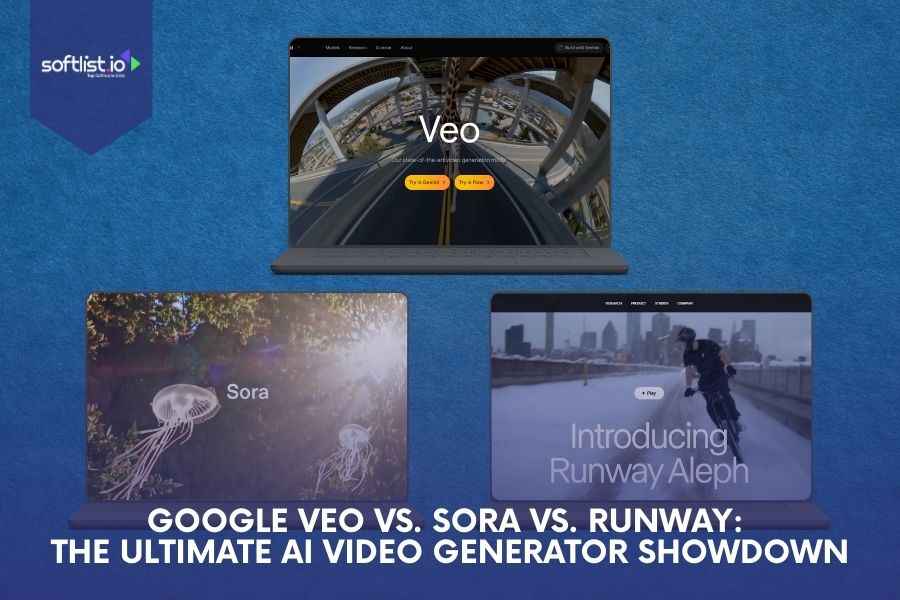
The race to dominate AI-powered video creation intensifies in 2025. Google Veo 3, OpenAI Sora, and Runway Gen-3 emerge as frontrunners—sparking debates like Google Veo vs Sora among creators, each giving creators distinct ways to transform text into cinematic-quality clips. These platforms don’t just generate video—they set new standards for realism, storytelling, and accessibility.
This guide delivers a comprehensive, side-by-side analysis of these leading platforms. You will learn where each excels, how they differ in output, and which one is best suited for your creative goals.
Key Takeaways
- Google Veo 3 delivers the most cinematic visuals with native audio, best for professional projects.
- OpenAI Sora generates longer clips with strong narrative consistency, ideal for storytelling.
- Runway Gen-3 offers the most user-friendly platform with real-time editing and affordable plans.
- Each tool specializes differently—Veo for realism, Sora for narrative flow, and Runway for speed and accessibility.
- The best choice depends on your priorities: polish, story, or quick content creation.
Platform Overviews: Google Veo vs Sora vs. Runway
Every platform approaches AI video generation from a different angle—especially when comparing Google Veo vs Sora vs Runway, which differ in realism, storytelling focus, and accessibility.
- Google Veo 3 emphasizes realism and professional-grade output
- OpenAI Sora prioritizes storytelling with longer durations, and
- Runway Gen-3 offers intuitive tools that make video editing accessible to both beginners and professionals.
Google Veo 3
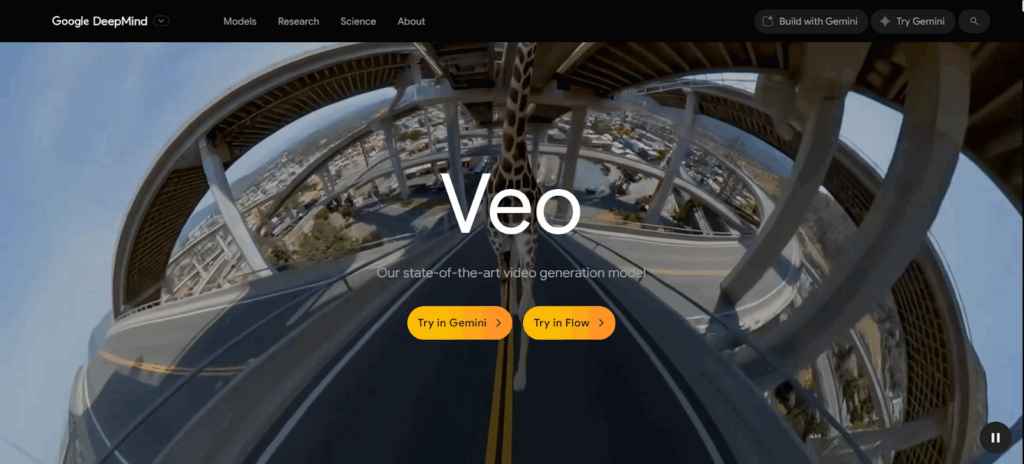
Source: Google Deepmind
Google’s Veo 3 is built for creators who demand cinematic realism. It produces 8- to 12-second clips in up to 1080p resolution with full native audio support, enabling the capture of dialogue, ambient sounds, and special effects.
The model excels when you provide detailed prompts specifying lighting, angles, and scene design. Veo also incorporates a physics-aware rendering engine that produces highly realistic water movement, smoke, and particle effects.
What Sets Veo Apart
What sets Veo apart in 2025 is the release of Veo 3 Fast, which reduces generation times while maintaining fidelity. This makes it practical for use in commercial projects where turnaround matters. Professional studios, advertisers, and filmmakers are already experimenting with Veo for short cinematic spots and product showcases.
OpenAI Sora

Source: OpenAI Sora
OpenAI’s Sora is designed for narrative continuity. It generates clips up to 20 seconds long at 1080p, making it more flexible for storytelling than Veo’s shorter outputs. Although all videos are silent, Sora maintains impressive consistency in character appearance, camera perspectives, and scene transitions—qualities essential for storyboards and concept development.
What Sets Sora Apart
Because Sora is integrated into ChatGPT Plus ($20/month) and Pro ($200/month), it appeals to creators already embedded in OpenAI’s ecosystem. Its natural-language-friendly prompting reduces the technical barrier, allowing you to describe a scene casually and still receive coherent, visually accurate output. For marketing teams and creatives focused on storytelling, this balance of length and coherence is a major advantage.
Runway Gen-3

Source: Runway
Runway has carved out its niche by offering the most accessible AI video generator. The Gen-3 Alpha produces 10-second clips at 1080p resolution, supported by background music integration. Unlike Veo or Sora, Runway places heavy emphasis on editing flexibility.
Its real-time preview system allows users to adjust prompts and settings mid-generation, saving time lost on trial and error.
What Sets Runway Apart
Runway also integrates smoothly with tools like Adobe Premiere Pro and Final Cut Pro, making it easy to import AI-generated clips into existing workflows. It offers a free tier with 125 one-time credits, while paid plans start at approximately $12–$ 76 per month, appealing to creators ranging from TikTok influencers to design studios.
Resolution and Output Quality

Source: Canva
Video quality is often the deciding factor in choosing a platform, and the Google Veo vs Sora debate highlights how differently each tool approaches output.
- Google Veo 3: Google Veo 3: Produces the sharpest and most cinematic results, but clips are limited to 8 seconds. In a Google Veo vs Sora comparison, Veo clearly wins in realism and audio fidelity. Audio is a major differentiator, offering synchronized dialogue and ambient effects.
- OpenAI Sora: OpenAI Sora: Prioritizes narrative over resolution, outputting 20-second clips at 1080p. Within the Google Veo vs Sora matchup, Sora dominates when it comes to longer storytelling sequences. While silent, its consistency in character design makes it ideal for storyboarding and animation prototypes.
- Runway Gen-3: Matches Sora’s 1080p quality but focuses on ease of use and speed. Clips are limited to 10 seconds, yet its outputs remain stable and suitable for casual and commercial projects.
For filmmakers, Veo’s realism makes it indispensable, while for storytellers, Sora’s longer clips create continuity. The Google Veo vs Sora trade-off ultimately comes down to realism versus narrative flow. For creators under deadlines, Runway strikes a balance between speed and accessibility.
Prompting and Creative Control
Source: Canva
The quality of an AI’s interpretation of your prompt determines how much time you spend refining the outputs, and the Google Veo vs Sora comparison perfectly illustrates this difference.
- Google Veo 3 rewards technical precision. Filmmakers familiar with cinematography can direct Veo like a digital camera, specifying lens types, shot angles, and lighting setups. This steepens the learning curve but delivers unmatched realism. In the Google Veo vs Sora contrast, Veo appeals to filmmakers who value precision over simplicity.
- OpenAI Sora lowers the barrier with natural-language prompting. Simply describing “a child running through a rainy street at night” yields a coherent, visually consistent clip without technical phrasing, making the Google Veo vs Sora trade-off clear: realism versus accessibility.
- Runway Gen-3 balances both. It accepts casual prompts but also lets you refine results within its editor—adjusting colors, transitions, or camera pans after generation.
Runway has recently advanced this even further with natural language editing, allowing creators to request new shots, angles, or stylistic changes directly through conversational text prompts. Instead of relying only on sliders or re-rendering, users can interact with their video model as if giving instructions to an assistant, making Runway one of the most user-friendly platforms available today.
This divergence highlights their audiences and underscores the ongoing Google Veo vs Sora debate: professionals lean toward Veo’s realism, while marketers favor Sora’s narrative ease.
Physics and Motion Realism

Source: Canva
A video isn’t judged by clarity alone; realism in physics and movement determines whether it feels authentic, and the Google Veo vs Sora comparison shows two different strengths.
- Sora leads in object interactions, producing natural human motion and believable physical reactions—one of the reasons many creators frame the discussion as Google Veo vs Sora.
- Veo dominates in lighting, shadows, and environmental realism, especially in complex outdoor or cinematic scenes. In the Google Veo vs Sora matchup, Veo clearly wins on cinematic visuals.
- Runway performs consistently in character expressions and gestures, an advantage for social content and educational material.
All three handle basic environments well, but the Google Veo vs Sora comparison highlights Veo’s cinematic dynamics versus Sora’s physics accuracy for professional applications.
Pricing and Accessibility

Source: Canva
Budget matters, especially for independent creators and small businesses, and the Google Veo vs Sora comparison is often the deciding factor when weighing cost against features.
Runway Gen-3 offers the lowest entry barrier with a free tier (125 credits) and paid plans starting at $12–15/month. This makes it the most approachable option for casual creators and small teams.
Google Veo 3, by contrast, uses a subscription + usage model:
- Google AI Pro Plan ($20/month): Includes around 1,000 credits monthly, equivalent to 50 short “Fast” clips or 10 higher-quality outputs.
- Google AI Ultra Plan ($250/month): Expands this to 12,500 credits, watermark-free exports, extended durations, and early access to new features.
- Vertex AI Pay-per-use: For enterprise or API integrations, Veo pricing is billed per second, with rates ranging from $0.25 to $0.40/second for Veo 3 Fast and $0.50 to $0.75/second for Veo 3 Quality, depending on whether audio is included. In a Google Veo vs Sora pricing discussion, Veo tends to be costlier but offers cinematic realism with native audio.
OpenAI Sora sits in the middle, integrated into ChatGPT Plus ($20/month) and Pro ($200/month). Plus users can generate shorter 720p clips, while Pro users unlock up to 20-second, 1080p videos with unlimited generations. Compared side by side, the Google Veo vs Sora trade-off becomes clear: Sora delivers more output for a flat monthly rate, while Veo charges per second of cinematic quality.
Workflow Integration

Source: Canva
An AI tool’s usefulness is amplified when it fits smoothly into your production workflow.
- Runway Gen-3 excels with its editor-friendly interface and direct integrations with Adobe and Final Cut Pro. Teams can generate and edit without switching environments.
- Google Veo 3 feels like a professional production tool. It provides granular control over visuals but requires technical expertise, making it more suitable for film studios and advanced creators.
- OpenAI Sora integrates seamlessly with the ChatGPT ecosystem, enabling creators to ideate, script, and generate video content all in one platform. Its simplicity appeals to marketers and creative writers.
Notable Contenders in the AI Video Generation Space

Source: Canva
While the Google Veo vs Sora debate and Runway Gen-3 dominate the spotlight, they are not the only platforms pushing innovation in AI video. Several other contenders are carving out their own niches, offering specialized features that may appeal to creators with specific needs.
These tools often focus on avatars, marketing workflows, or automated editing, complementing rather than competing directly with the “big three.” Even as the Google Veo vs Sora matchup grabs headlines, these contenders offer niche strengths worth exploring.
HeyGen
HeyGen has gained popularity for combining AI avatars with multilingual capabilities. Unlike Veo or Sora, it isn’t about cinematic storytelling but about creating presenter-style videos where a digital human speaks naturally in dozens of languages. For global brands and online educators, this is a game-changer—one video can be repurposed across multiple markets without expensive reshoots.
- Strength: Realistic avatars with natural lip-sync and expressions.
- Best Use Case: Corporate presentations, online courses, multilingual marketing campaigns.
- Starting Price: Around $29/month.
Write your script (or get some help with built-in ChatGPT), and watch an avatar read it flawlessly in one take. Need to change something? No reshoots necessary, just edit the text.


DeepBrain AI
DeepBrain AI specializes in hyper-realistic avatars that rival human presenters. Its outputs often surpass the realism of Runway’s characters, though the focus is narrower. Rather than cinematic effects, DeepBrain is designed for tutorials, training, and virtual spokespersons. Industries like finance, healthcare, and education use it to deliver consistent, human-like communication without relying on on-camera staff.
- Strength: Photorealistic avatars with strong facial detail.
- Best Use Case: Training videos, news-style presentations, customer service automation.
- Starting Price: Around $24/month.
Turn pictures or videos into works of art. You can also edit only the background or only the foreground. Use a variety of parameters to create your individual artwork. Render images in any resolution.

Creatify
Creatify takes a marketing-first approach, catering specifically to businesses that need polished promotional content quickly. Instead of focusing on realism or physics, it offers pre-built templates and ad-oriented workflows. This makes it attractive to agencies and startups that want ad spots, social posts, or landing-page videos without hiring a creative team.
- Strength: Pre-made marketing templates for rapid production.
- Best Use Case: Ad campaigns, product demos, social media promotions.
- Starting Price: Around $19/month.
Simply enter a product link or upload your own visuals and descriptions, and Creatify will do the rest. Don't let limited marketing resources hold you back from success.

Revid.ai
Revid.ai is not a generator in the same sense as Veo or Sora but rather a video repurposing engine. It specializes in automated editing of long-form content into short, shareable clips. Creators who generate high-quality videos on Veo, Sora, or Runway can use Revid.ai to transform them into social-ready content for platforms like TikTok, YouTube Shorts, or Instagram Reels.
- Strength: Automated short-form editing with viral potential.
- Best Use Case: Content creators and marketers needing fast repurposing workflows.
- Starting Price: Around $39/month.

Final Verdict
In the ultimate showdown, each platform has a clear winner depending on your priorities. Google Veo 3 is best for cinematic realism and audio-driven content. OpenAI Sora excels in longer storytelling, maintaining narrative consistency. Runway Gen-3 remains the most approachable option for rapid, everyday content creation. The choice ultimately depends on whether your workflow values polish, story, or speed.
Looking for the best AI video generator without overspending? At Softlist.io, we bring you exclusive deals, promotions, and in-depth reviews that help you save while creating smarter. Explore our curated rankings today and discover the top AI tools shaping video in 2025.
FAQs
Which one is the best AI video generator?
The best text-to-video AI depends on your creative priorities. Google Veo 3 offers unmatched cinematic realism with native audio, making it ideal for professional-grade projects. OpenAI Sora stands out for storytelling with more extended sequences and character consistency, while Runway Gen-3 provides the most accessible interface for everyday creators. In short, the “best” choice comes down to whether you need cinematic quality, narrative flow, or quick editing.
Is Veo better than Sora?
In a direct Veo vs Runway vs Sora comparison, Veo produces the most realistic visuals and audio, but Sora excels in narrative coherence and longer durations. If your project requires polished, film-like clips, Veo is the stronger option. If you need extended storytelling with smooth transitions, Sora offers a better fit. Both tools serve different purposes, and many creators use them simultaneously.
Which AI is better than Sora?
No single tool is universally “better” than Sora—it depends on the use case. For example, Veo outperforms Sora in video generator quality and cinematic detail, while Runway delivers faster outputs and easier integration into editing workflows. However, Sora remains unique in its ability to support natural-language prompting and coherent storylines, making it the go-to choice for narrative-driven content.
What are the key OpenAI Sora features?
Sora’s standout features include natural-language-friendly prompting, longer video durations (up to 20 seconds), and strong character consistency. While it does not yet generate audio, it excels in maintaining narrative flow, making it particularly useful for marketing campaigns, storyboards, and conceptual animations.
How do I choose between these platforms?
When evaluating tools in an AI video comparison, consider your budget, workflow, and creative goals. Veo works best for professionals aiming for polished 8 to 12-second clips, Sora benefits storytellers and marketers needing longer sequences, and Runway appeals to beginners or teams that value speed and affordability.